
Description
An All-White Rochet for Episcopal Wear
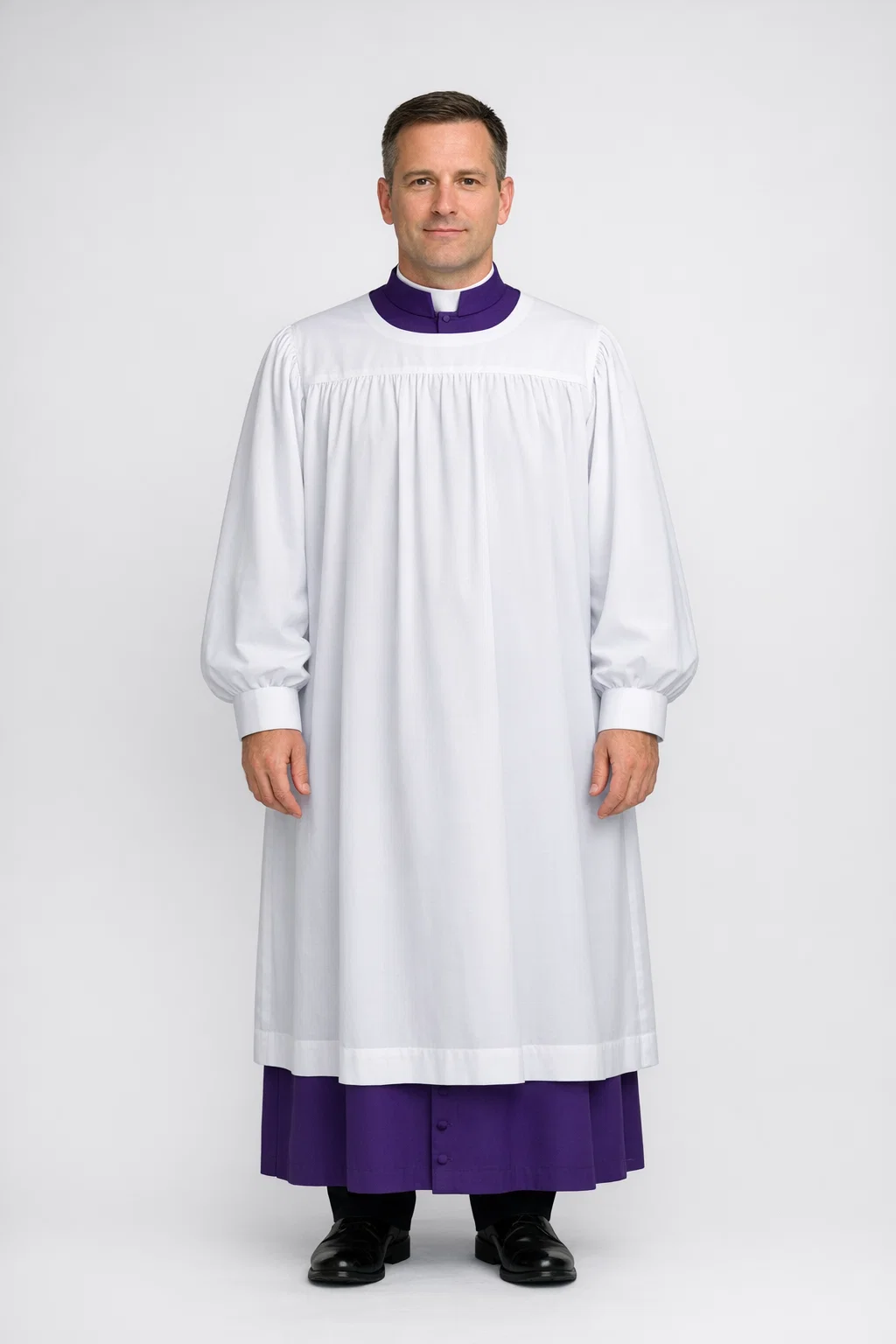
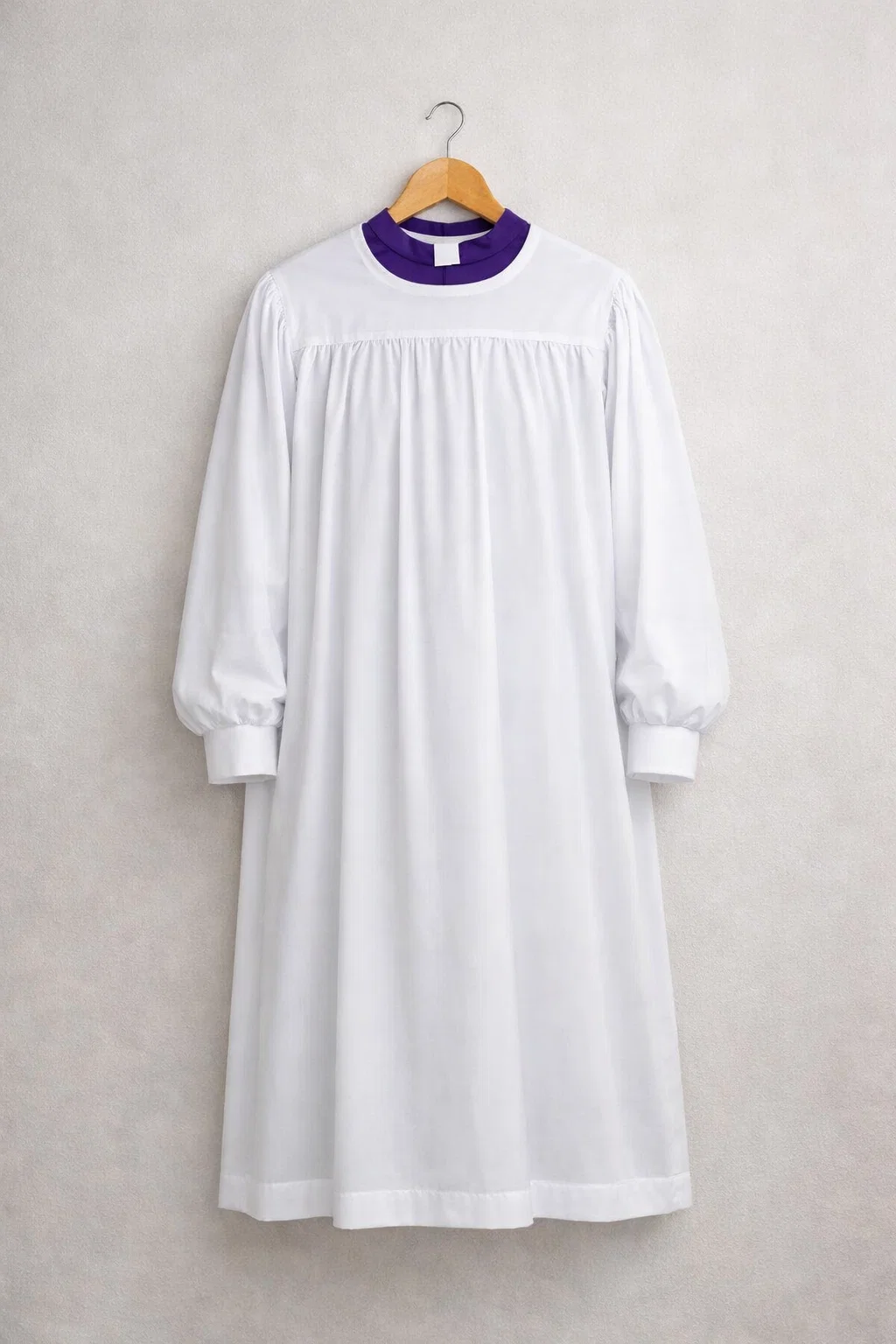
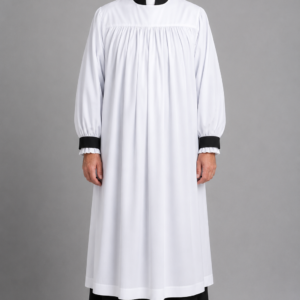
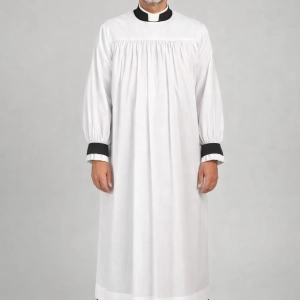
Domini is the all-white counterpart to Custodis. Where Custodis follows the Anglican convention of black cuff bands and a black hem band against a white body, Domini eliminates the contrasting bands entirely. The cuffs, hem, and body are all the same white Toyobo fabric, giving the rochet a unified, single-tone appearance from neckline to floor.
The all-white rochet is the Roman Catholic standard. In Roman Catholic usage, the rochet worn by bishops is traditionally white throughout, with lace at the cuffs and hem in its most formal version, or plain white bands in its everyday version. Domini follows the everyday form: plain white bands, no lace, no contrasting colour. It is shown in the product images worn over a purple cassock, which is the daily cassock colour for Roman Catholic bishops and the standard under-garment for a rochet in episcopal service.
White Cuff Bands with Button Closure
The bishop sleeves on Domini are the same full, blouson construction as Custodis: cut very wide through the upper arm and forearm, then gathered into a snug band at the wrist. The difference is that Domini’s cuff bands are white and close with a single visible button at the wrist.
The button closure gives the cuff band a functional adjustment point. The button can be left unfastened for a slightly looser fit at the wrist or fastened for a snug cinch that holds the gathered sleeve firmly in place. On Custodis, the black cuff bands are a fixed cinch with no button; on Domini, the button adds a small amount of practical flexibility.
The absence of a contrasting cuff colour means the eye reads the sleeve as a continuous white line from the shoulder to the hand. The blouson shape is still visible through the gathered volume, but the cuff transition is softer than on Custodis, where the black band creates a hard line between the white sleeve and the wrist.
The Purple Cassock Pairing
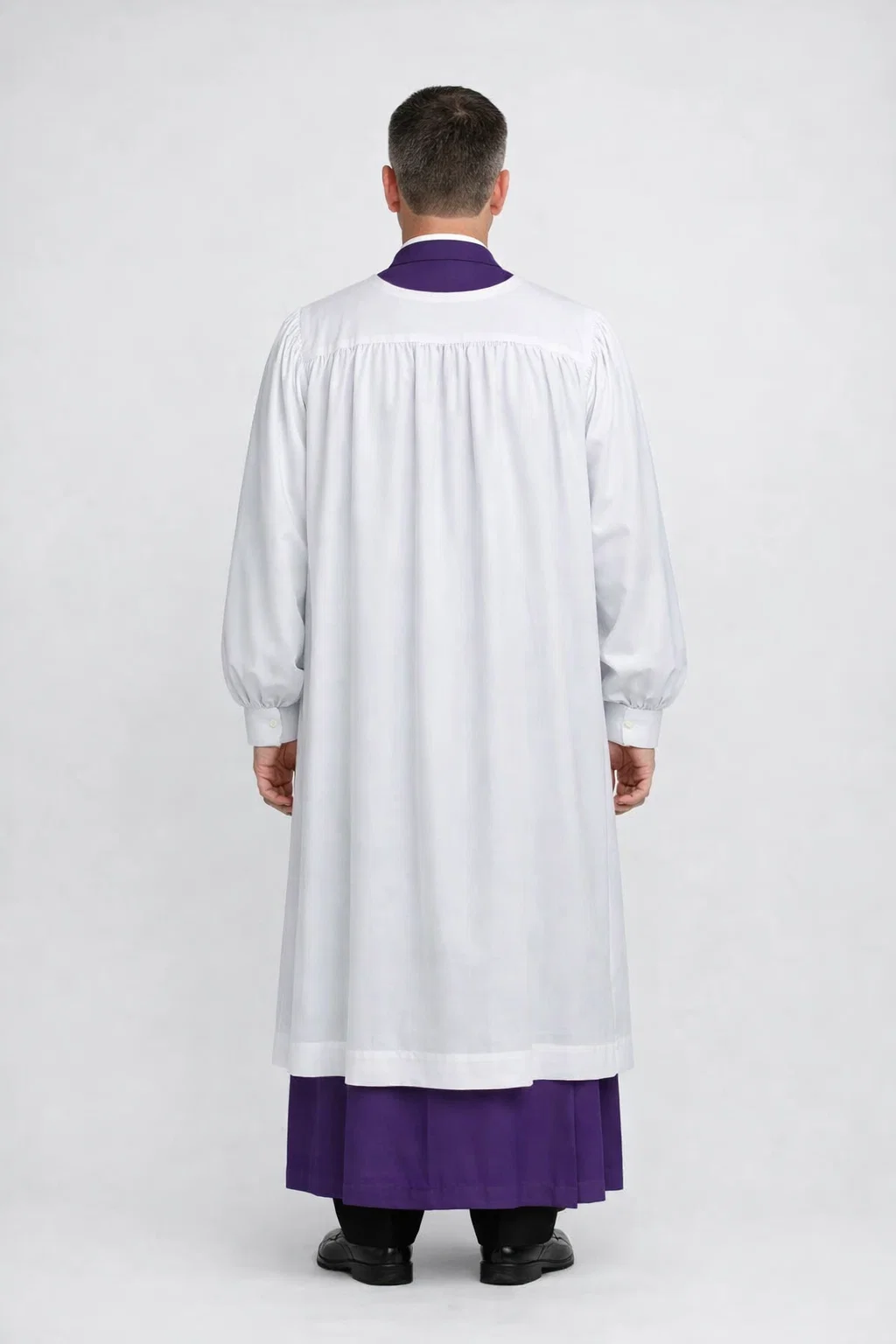
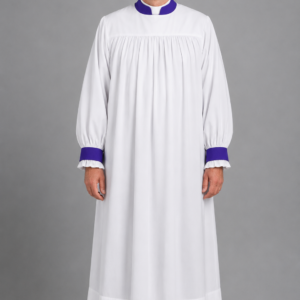
The product images show Domini worn over a purple cassock. In Roman Catholic episcopal dress, the purple cassock is the bishop’s daily garment, and the white rochet worn over it is the standard combination for non-liturgical formal occasions: diocesan meetings, episcopal visitations, audiences, and any setting where the bishop is in choir dress rather than full Mass vestments.
The all-white rochet against the purple cassock produces a different visual balance than the black-banded Custodis over a black cassock. The purple collar and lower cassock skirt are visible above and below the white rochet, giving a purple-white-purple layered sequence that is immediately associated with episcopal rank in the Roman Catholic tradition.
Body Construction
The body is gathered from a flat yoke that sits across the chest and upper back, matching the Custodis construction. Below the yoke seam, the fabric falls in soft gathered folds to the hem. The length sits at mid-calf to near-ankle, showing the lower portion of the cassock beneath. The round gathered neckline sits at the base of the throat, leaving the cassock’s stand collar visible above.
The rochet is a pull-on garment with no closure at the body. The only functional fastening on the entire garment is the button on each cuff band.
Fabric and Care
Domini is made from soft Toyobo fabric, the same lightweight woven used on Custodis. The Toyobo has a smooth, matte finish with a subtle polish that reads as refined rather than shiny. On an all-white garment, the consistent sheen behaviour across the yoke, gathered body, and cuff bands matters; a fabric with uneven sheen would catch light differently at the yoke (flat panel) and the body (gathered folds), creating an inconsistent appearance.
Care: dry clean recommended for the crispest finish. If home laundering, machine wash cold with whites only and hang to dry. Because Domini has no contrasting bands, there is no risk of dye migration between black and white components, which makes home laundering simpler than for Custodis. Steam rather than press; a hot iron on the gathered sections will flatten the bishop sleeve volume.
Sizing and Made to Measure
Domini is available across a range of sizes for clergy. Size by height and shoulder width. The all-white construction means any proportion error (too long, too short) is more visible than on a two-tone rochet because there is no contrasting hem band to anchor the eye. Accurate height sizing keeps the hem sitting at the correct mid-calf to near-ankle position.
Made to measure is available with a 3 to 4 week lead time. For episcopal households ordering a rochet to pair with a specific purple cassock, we can match the white shade and length to the wearer’s exact measurements.
FAQs
How is Domini different from Custodis?
Custodis has black cuff bands and a black hem band against the white body, following the Anglican convention. Domini is all white with white cuff bands and a white hem band, following the Roman Catholic convention. Domini also has a button closure on each cuff band, while Custodis uses a fixed cinch. The fabric, sleeve construction, and body pattern are otherwise identical.
Can Domini be worn over a black cassock instead of purple?
Yes. The all-white rochet sits well over any cassock colour. Over a black cassock it reads as a simpler, less contrasted combination than Custodis because there is no black-on-black matching between the cuff bands and the cassock. Over purple, red, or blue it reads as an episcopal garment in formal choir dress.
Is a lace-trimmed rochet more correct for a bishop than a plain one?
In Roman Catholic usage, lace at the cuffs and hem is the most formal version of the rochet and is worn for pontifical ceremonies. A plain white rochet like Domini is the everyday form, worn for choir dress, diocesan business, and non-liturgical formal occasions. Both are correct; the distinction is one of formality rather than correctness.
Does the button on the cuff band need to match any specific style?
The button is a small, white, tone-on-tone button that sits flush against the cuff band. It is not decorative; it is a functional closure that holds the gathered sleeve at the wrist. No matching or coordination with other vestment buttons is needed.
There are no reviews yet. Be the first one to write one.