
What This Robe Is
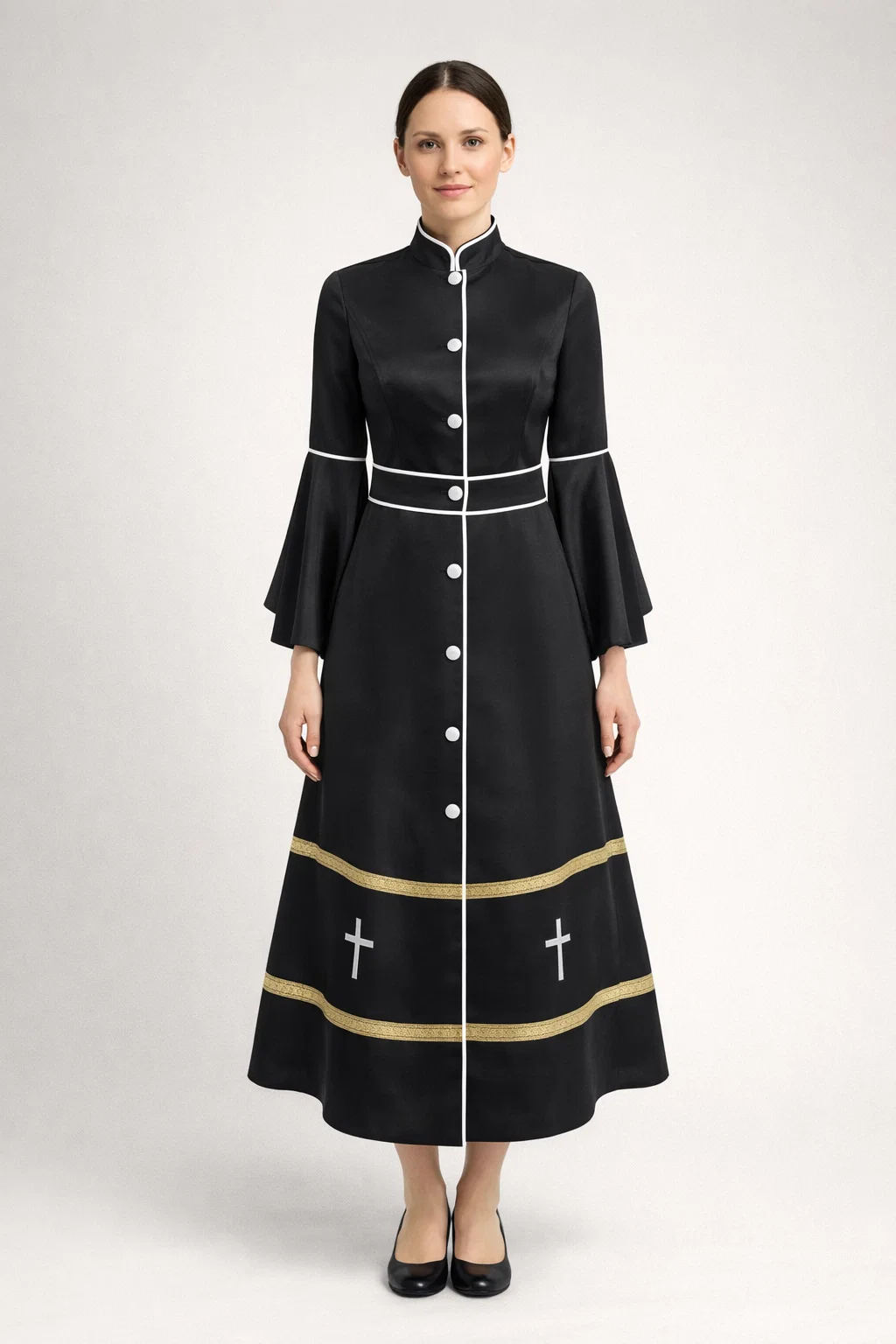
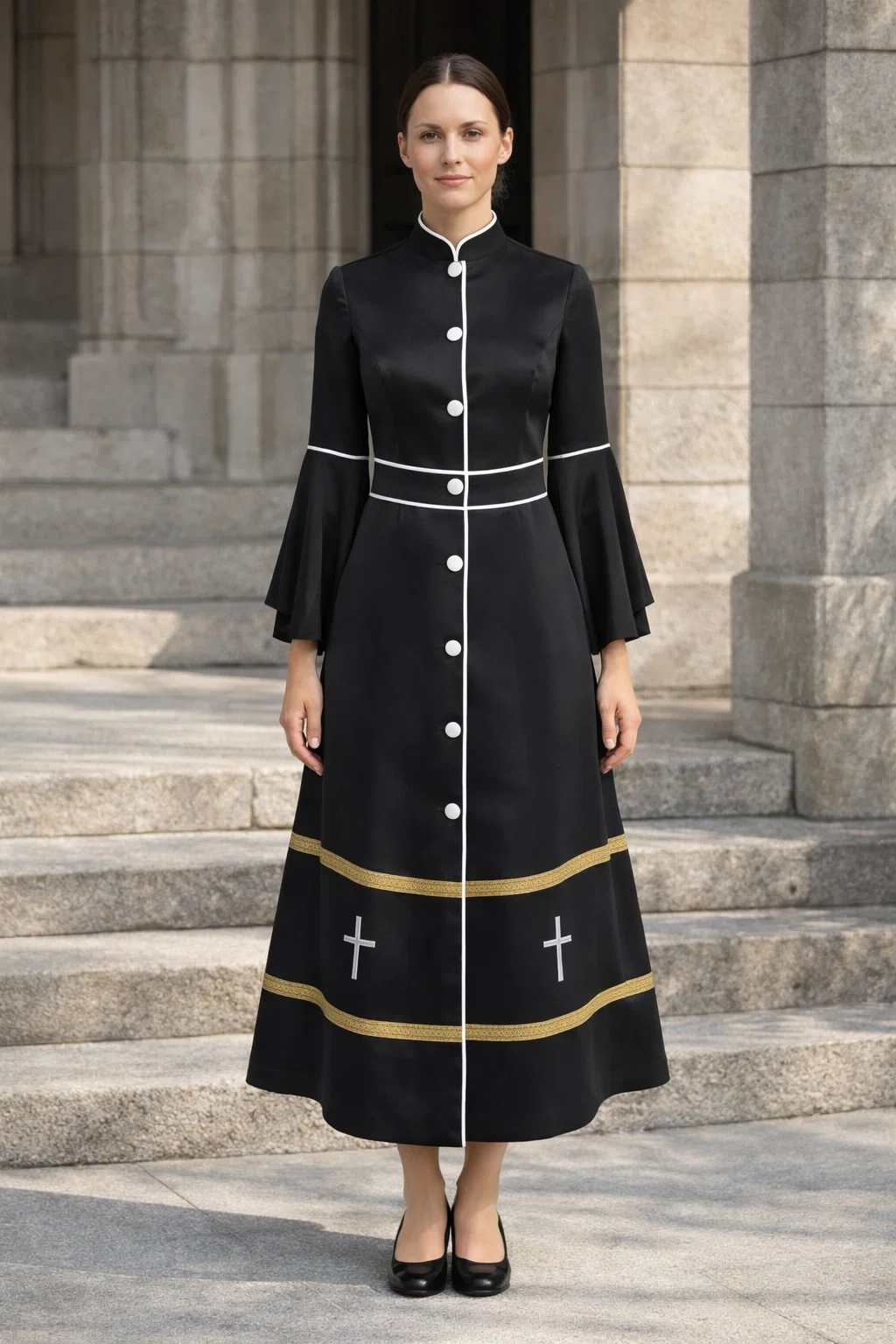
The Noir is a women’s robe in the tradition of the Church of God in Christ, the National Baptist Convention and the wider historically Black Pentecostal and Baptist churches. The design language is specific and unmissable: white ball buttons down the front, white piping tracing the collar and waist, bell sleeves ringed with a white piping band, and two horizontal gold galloon bands at the hem with white embroidered Latin crosses between them.
This is the robe that has been worn by women bishops, elders, evangelists, mothers of the church and first ladies in this tradition for generations. It carries authority in the pulpit. It reads correctly at annual convocation, at holy convocation, at ordination services, at anniversary services and at any gathering where the vesture itself is expected to declare the wearer’s office.
The Vestment Elements
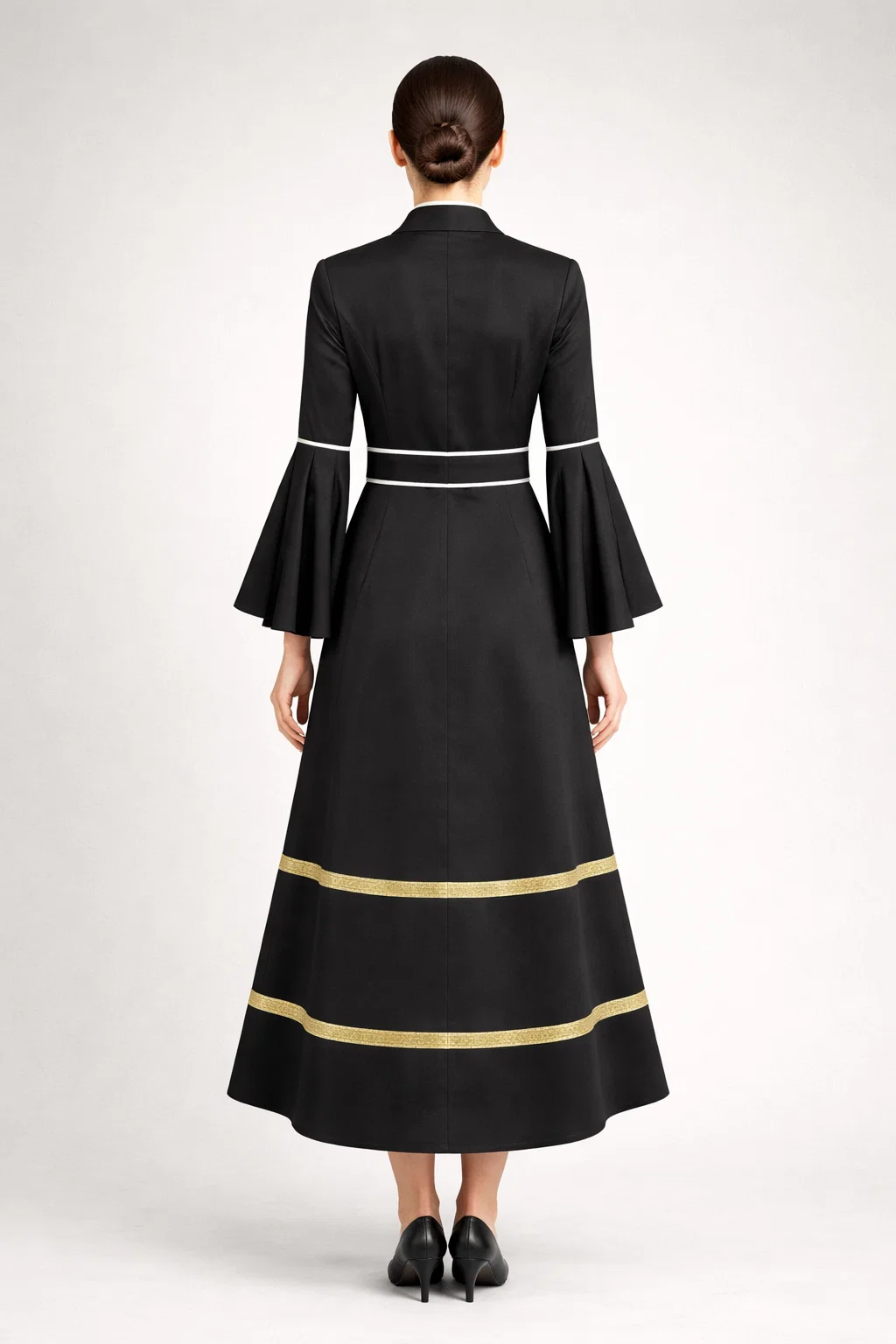
The gold bands are the highest-visibility element. Two horizontal bands of metallic gold galloon run around the skirt, one at approximately knee height and the second parallel to it just above the hem. The space between them is where the two crosses sit: one on the left skirt panel and one on the right, embroidered in matching white on the black ground, sized to read from the back of a full sanctuary.
The gold galloon itself is the traditional ecclesiastical trim used on clergy vesture across many traditions, and it is what places this robe unmistakably in the vestment category rather than in the ordinary clergy dress category. Its metallic finish catches sanctuary lighting and reads distinctly on video.
Above the hem detail, the front of the robe carries a full row of covered white ball buttons running from the collar to the hem down the center. Each button sits on a white piped placket, so the buttons and the piping read as a single continuous vertical line. That vertical divides the front of the robe symmetrically and holds attention at the center as the wearer moves.
At the waist, an empire-height piped band sits just under the bust rather than at the natural waist. That placement is the traditional height for women’s clergy dress in this tradition, and it is what gives the silhouette its distinctive proportion: a high fitted bodice releasing into a long full skirt below.
The Sleeves and the Collar
The bell sleeves are fitted through the shoulder and upper arm, released into a full bell from the elbow to the wrist. A band of white piping rings the sleeve at the point where the fitted section meets the bell, echoing the empire waistband in position and finish. The bells themselves are cut generously so they move with an outstretched arm during preaching, benediction and the laying on of hands.
The stand collar is cut at the traditional height and edged with the same fine white piping. The collar can be worn open at the throat or closed with a preaching tab, depending on the occasion and the wearer’s preference.
Fabric and Care
Cut from a lightweight tropical fabric. In a full length robe with gold trim and embroidery worn under sanctuary lighting through long services, the weave matters twice over. It moves air, which keeps the robe wearable through convocation, annual services and warm summer worship. And it drops creases on the hanger, which is what preserves the crispness of the piping, the flatness of the gold bands and the definition of the crosses.
The black face is matte, so the black stays deep and even in daylight and on camera. The white piping and buttons are cut in a crisp bright white. The gold galloon is a matte metallic weave rather than a shiny lamé, so it reads as ecclesiastical trim rather than as costume.
Care: dry clean recommended. The gold galloon and embroidered crosses will not survive a domestic wash cycle, so home laundering is not advised. Steam lightly on a hanger. Do not press hard along the galloon or crosses.


There are no reviews yet. Be the first one to write one.