
The Most Ornate Surplice in the Line
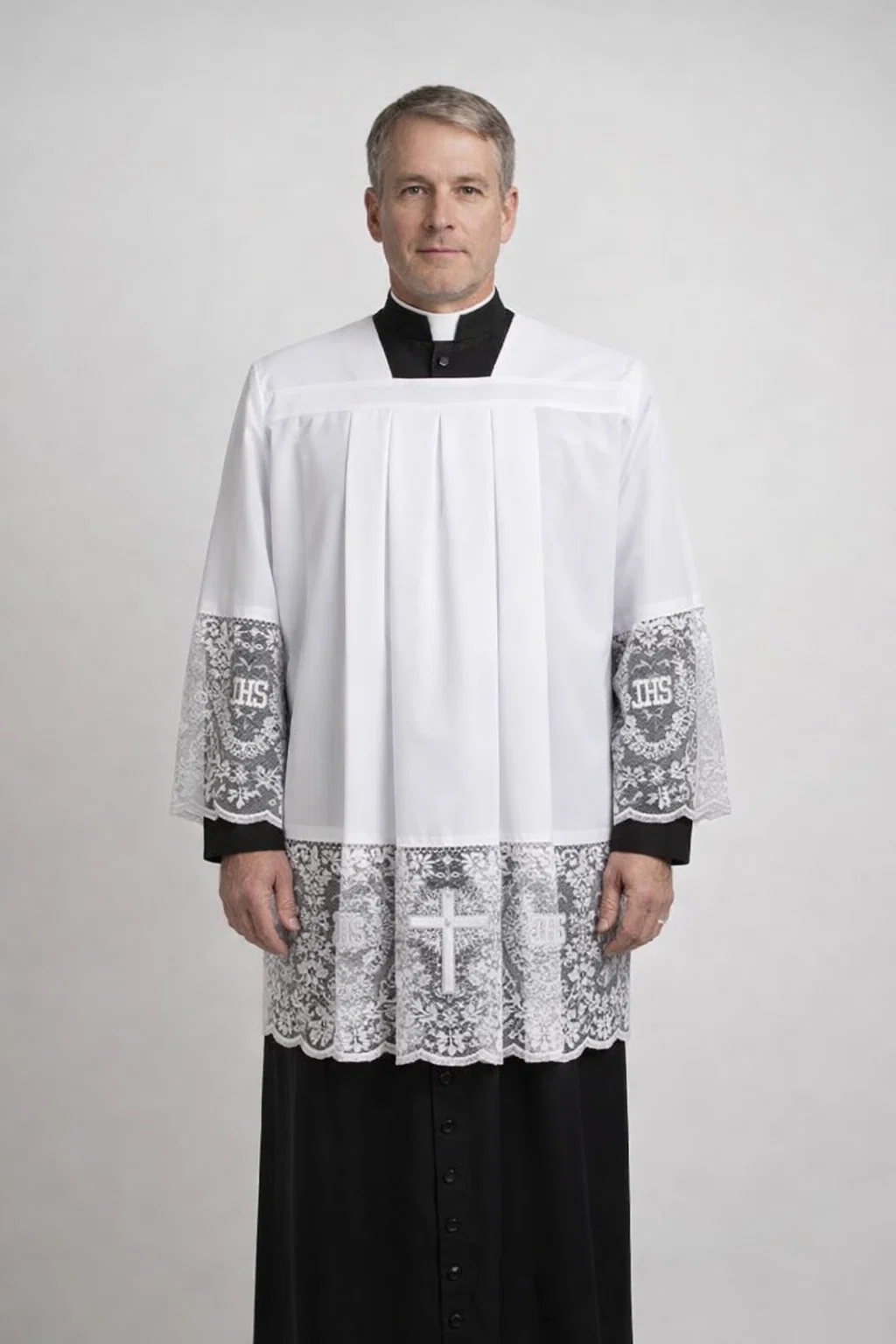
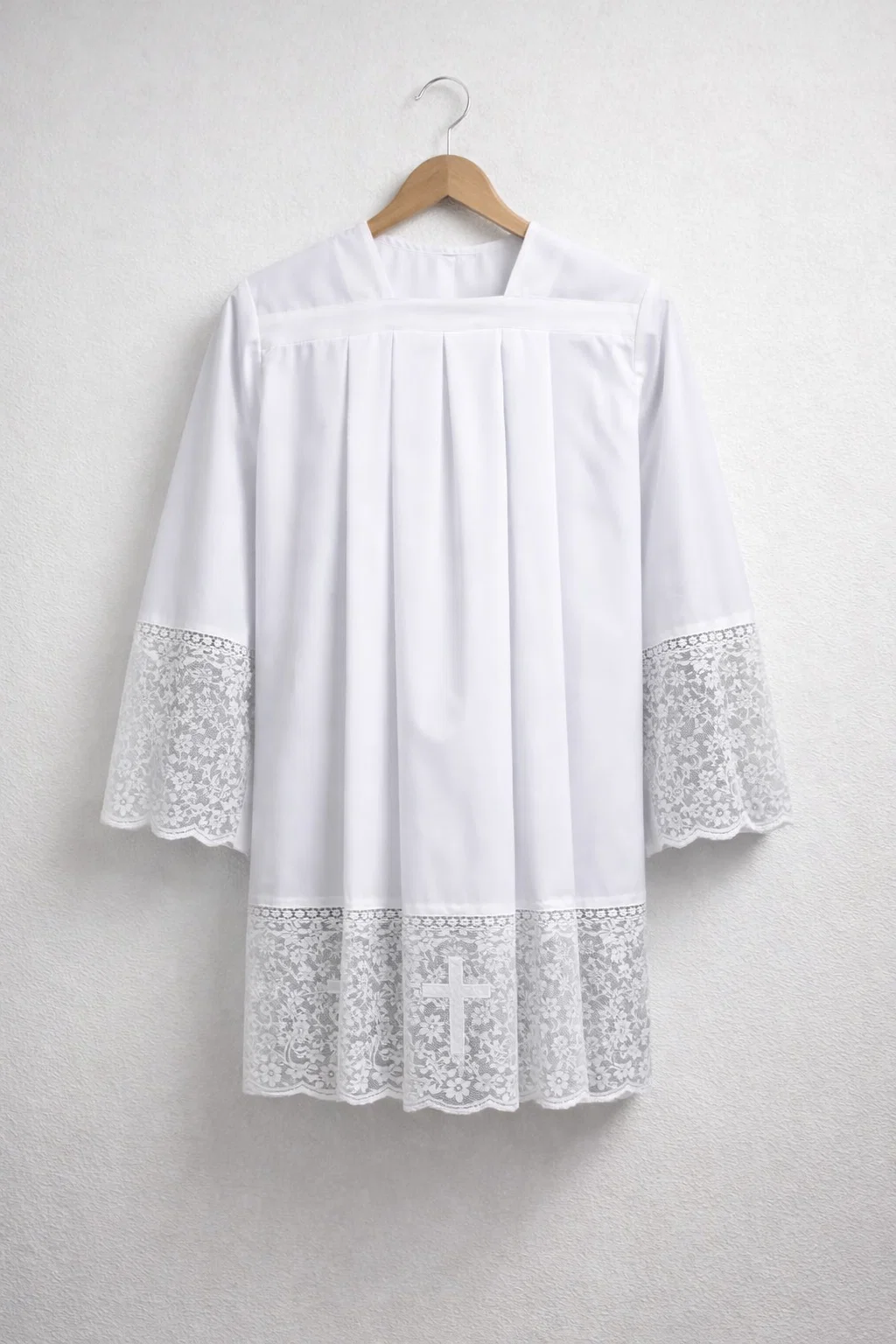
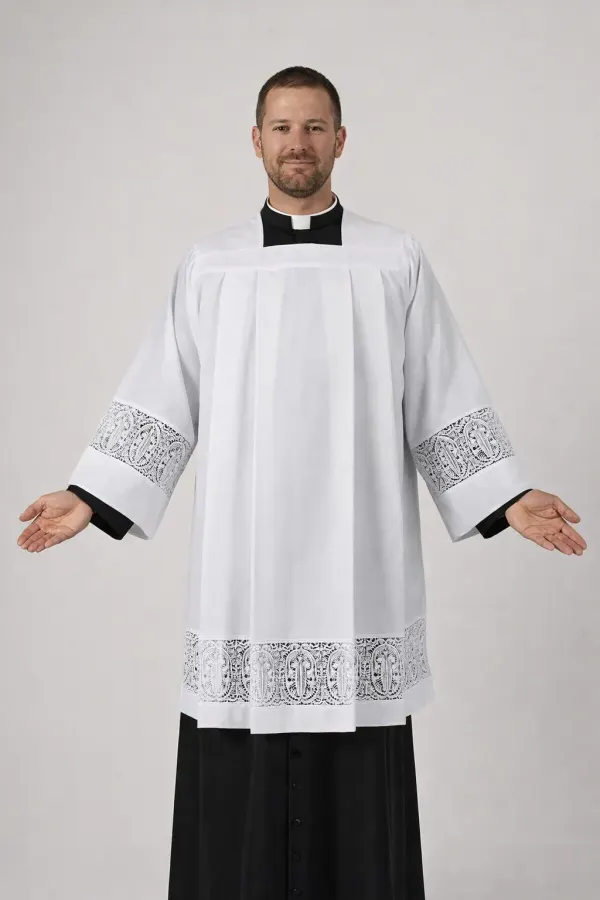
Sanctorum is the statement piece of the surplice range. The lace at the cuffs and hem is not a narrow insertion band set between strips of ground fabric; it is a deep, continuous lace panel that forms the entire lower section of the surplice and the lower half of each sleeve. The lace field is dense, with a floral ground carrying devotional imagery: IHS Christogram monograms at the cuffs and hem, a central Latin cross at the center front of the hem panel, and a scalloped edge that gives the surplice a finished ornamental termination rather than a straight cut.
This level of lace is reserved for the most formal occasions in Western liturgical worship. Corpus Christi processions, pontifical ceremonies, solemn high Masses, cathedral installations, and patronal feast days are the settings where Sanctorum belongs. It is not a daily-wear surplice.
The IHS Christogram in the Lace
IHS is one of the oldest Christograms in Christian use, derived from the first three letters of the Greek spelling of Jesus (ΙΗΣΟΥΣ) and later reinterpreted in Latin as “Iesus Hominum Salvator” (Jesus, Saviour of Mankind). The monogram appears in the cuff lace within a circular wreath motif, one on each sleeve, and again flanking the central cross in the hem panel.
Working a Christogram into vestment lace rather than embroidering it onto the fabric is a specific tradition associated with Roman Catholic and Anglo-Catholic surplice making. The monogram is part of the lace structure itself, which means it is visible as a white-on-white pattern against the cotton ground and as a white-on-dark pattern where the cassock shows through the openwork. The dual readability gives the IHS presence without requiring contrasting thread or colour.
The Hem Panel and Cross
The hem lace panel is deep enough that it occupies roughly the lower third of the surplice’s total length. At the center front, a Latin cross is worked into the lace field, rising from the scalloped edge and surrounded by the same dense floral ground that carries the IHS monograms at each side. The cross is the focal point of the surplice when seen from the front, and it sits at approximately waist height on the wearer, which means it remains visible even when the clergyman’s arms are at his sides and the cuff lace overlaps the body.
The scalloped edge at the hem and cuffs is the traditional termination for deep lace panels on liturgical vestments. The scallops are regular and evenly spaced, creating a gently undulating line rather than a straight cut. The scalloped edge catches light along its curves, which gives the surplice a soft visual finish rather than an abrupt stop.
Construction
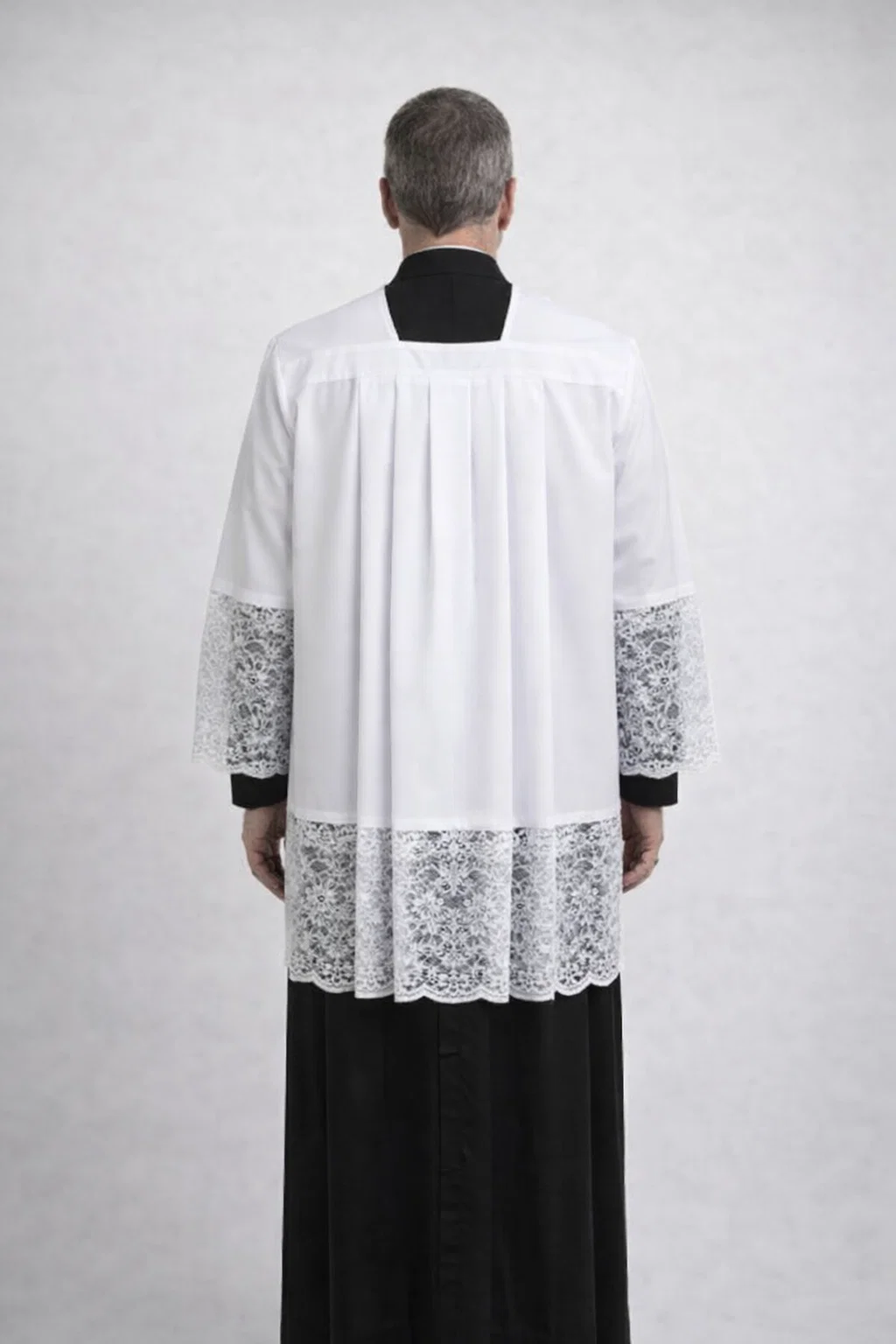
The upper body is the same box-pleated, flat-yoke construction used across the surplice line, with a square neckline and V-notch at center front. The pleats fall from the yoke seam to the point where the cotton ground meets the upper edge of the lace panel, and the lace continues the vertical line of the surplice from that junction to the scalloped hem.
The sleeves are three-quarter to full length. The lace panel on each sleeve occupies the lower portion of the sleeve from roughly the mid-forearm to the scalloped cuff edge. The cassock sleeve is clearly visible through the openwork lace, creating the same white-on-black layered effect seen on Pastoris but with the additional weight of the Christogram and floral patterning.
Fabric and Care
Sanctorum is made from a high quality cotton-rich fabric in a true white. The cotton ground provides a smooth, matte surface that transitions cleanly into the textured lace panels at the junction seams. The lace is lightweight enough to drape with the pleated body rather than stiffening the lower portion of the surplice.
The deep lace panels require careful handling during laundering. The larger the lace surface area, the more vulnerable it is to distortion under heat and mechanical agitation.
Care: hand wash or machine wash on a delicate cycle in cold water with whites only. Hang to dry while smoothing the lace panels and aligning the scalloped edges. Do not tumble dry. Do not press directly over the lace panels or the Christogram motifs; steam from the reverse side only. A mild oxygen-based brightener can be used on the cotton body; test any brightener on the lace in an inconspicuous area first. No chlorine bleach.
There are no reviews yet. Be the first one to write one.