
Description
What This Dress Is
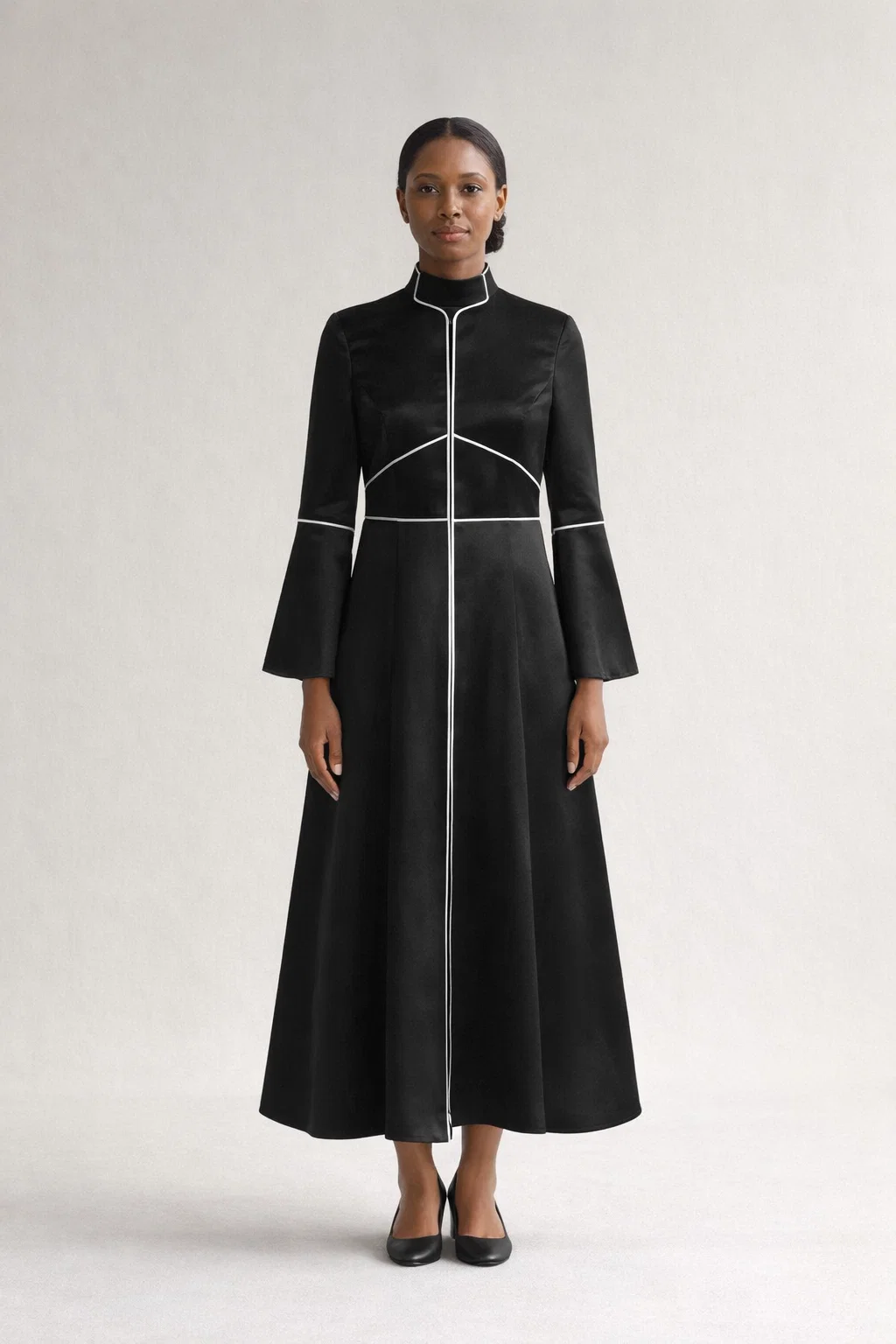
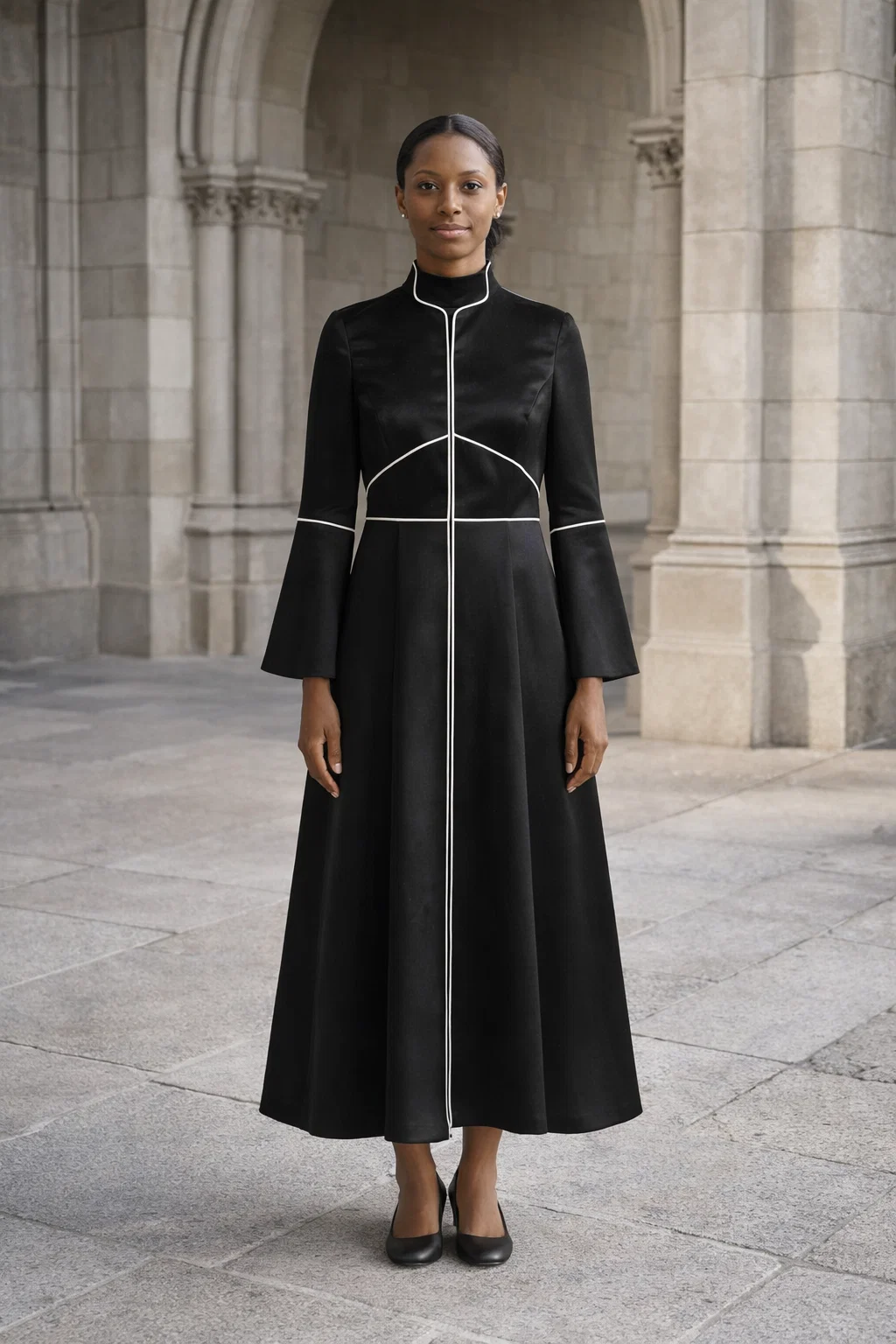
The Onyx is the ceremonial end of the black clergy dress line. Where the Ebony is deliberately plain and the Sable carries bold contrast panels, the Onyx works in a single restrained design language: fine white piping traces every architectural seam on the dress. The result is a garment that reads as ecclesiastical dress rather than as tailored clothing, drawing on the tradition of ecclesiastical galloon and braid that has marked formal cassocks and choir dress for centuries.
This is the dress for cathedral liturgy, ordinations, installations, episcopal visitations, and formal preaching in settings where the officiant is the visual anchor of the space. It is the piece to reach for when the occasion carries weight and the dress needs to hold that weight on its own.
The Piping and Where It Sits
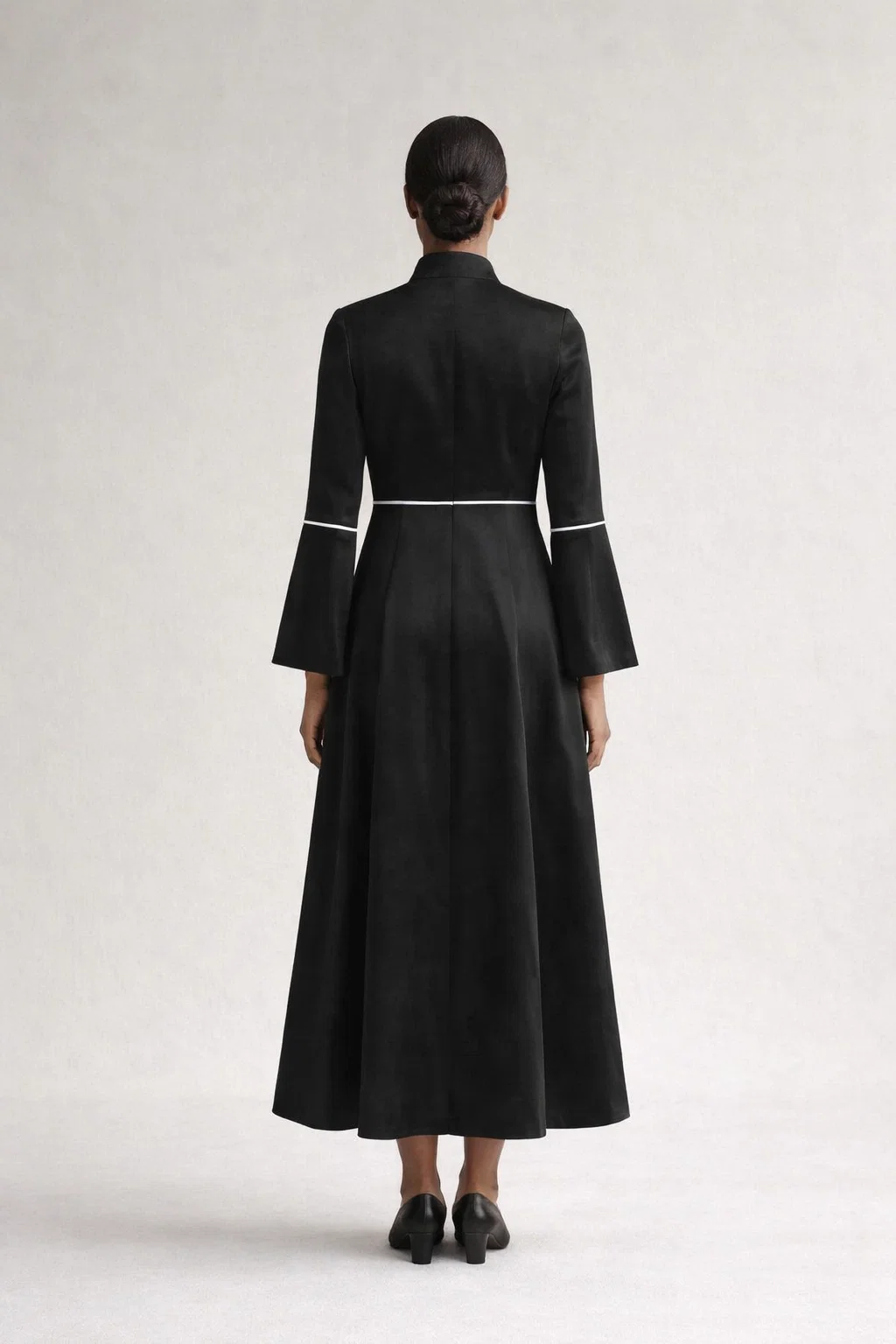
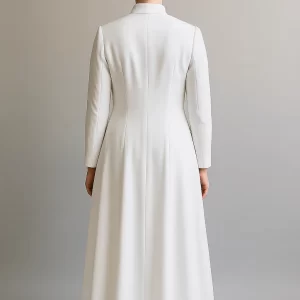
Fine white piping runs as a single continuous system across the whole dress. From the front the eye follows it from the top edge of the collar, down the exact center of the bodice to the hem, and outward in a soft curve that traces the yoke seam across the chest and the waist seam under the bust. From the back the same piping runs the full length of the center seam and rings each sleeve at the cuff.
That geometry is what makes the piping read as designed rather than as trim. It is following the actual construction lines of the dress — where the bodice meets the yoke, where the waist meets the skirt, where the sleeve meets the cuff — rather than sitting as decoration on top. The piping is inserted into the seams as the dress is built, not applied to the surface afterwards.
The width of the piping is deliberately fine, roughly two millimeters, so from a distance it reads as a soft line of light against the black rather than as a stripe. Under sanctuary lighting the piping catches highlights and defines the silhouette; on video it holds the shape of the dress on camera.
The Sleeves and the Silhouette
The sleeves are the second design signature. Cut fitted through the upper arm to the elbow and released into a moderate bell at the wrist, they widen enough to move with a raised arm during elevation, benediction or preaching without pulling at the shoulder. The cuff piping sits at the point where the bell begins, so the sleeve reads as two distinct sections framed by the white line.
The bodice is princess-seamed for a clean fit through the bust and waist, and the skirt releases into a full A line with generous sweep to the ankle-length hem. That combination gives the dress ceremonial presence in procession and behind the altar while keeping it practical to walk in.
The Collar
The stand collar is cut at the traditional cathedral height, edged with the same fine white piping along its top and front. The collar accepts a standard preaching tab, and it reads correctly with or without one. Without a tab it holds a plain sculptural line at the neck. With a tab the piping frames the tab cleanly against the black.
Fabric and Care
Cut from a lightweight tropical fabric. In a full length ceremonial dress with contrast piping worn under sanctuary lighting for extended services, the weave matters. It moves air, which keeps the dress wearable through procession, long liturgies and warm afternoons. And it drops creases on the hanger, which is what preserves the crispness of the piping against the black.
The black face is matte. The piping is a crisp bright white in the same weave, so the contrast reads as one intentional system rather than as trim added after the fact. Under sanctuary lighting the black stays deep and the piping reads clean.
Care: dry clean recommended, both to protect the black and to preserve the whiteness of the piping. Steam lightly on a hanger. Do not press hard along the piping seams, as pressure can flatten the raised line.
Sizing and Made to Measure
Standard sizing runs in four paired bands, XS/S through L/XL, with Plus 1X and Plus 2X for extended fit. Because the yoke and waist piping sit at fixed positions on the body, fit is more important on this dress than on plainer pieces in the line. If you sit between two bands, size to the smaller for a closer fit through the waist so the piping arcs sit at the intended points. Made to measure is the safer choice for a ceremonial dress you will wear on the most important occasions.
Made to measure accepts bust, waist, hip, shoulder, sleeve length and full length, with a lead time of about 3 to 4 weeks from confirmed measurements.
FAQs
Can the piping be ordered in a different color, such as red, purple or gold?
Not as a standard option. The white piping is designed as a single continuous system and is cut and inserted with the dress. For a piping color matched to a specific liturgical season, rank or academic tradition, contact us before ordering to discuss made to measure with a color change.
Does the collar take a standard clerical tab?
Yes. The stand collar is cut at the traditional cathedral height and sized to hold a standard preaching tab. Tabs are not included, since most women in ministry already own their own.
When would I choose this over the other black clergy dresses?
For the highest formality occasions — ordinations, cathedral liturgy, episcopal visitations, formal preaching where you are the primary visual. The Onyx is deliberately more architectural and ceremonial than the plainer Ebony or the working Umbra.
How does the paired sizing work, and which side of a band should I choose?
Each band serves two adjacent conventional sizes. Because the yoke and waist piping sit at fixed positions, size to the smaller for a closer fit through the waist so the arcs land at the intended points. Made to measure is the safer choice on a ceremonial piece.
There are no reviews yet. Be the first one to write one.