
Description
What This Robe Is
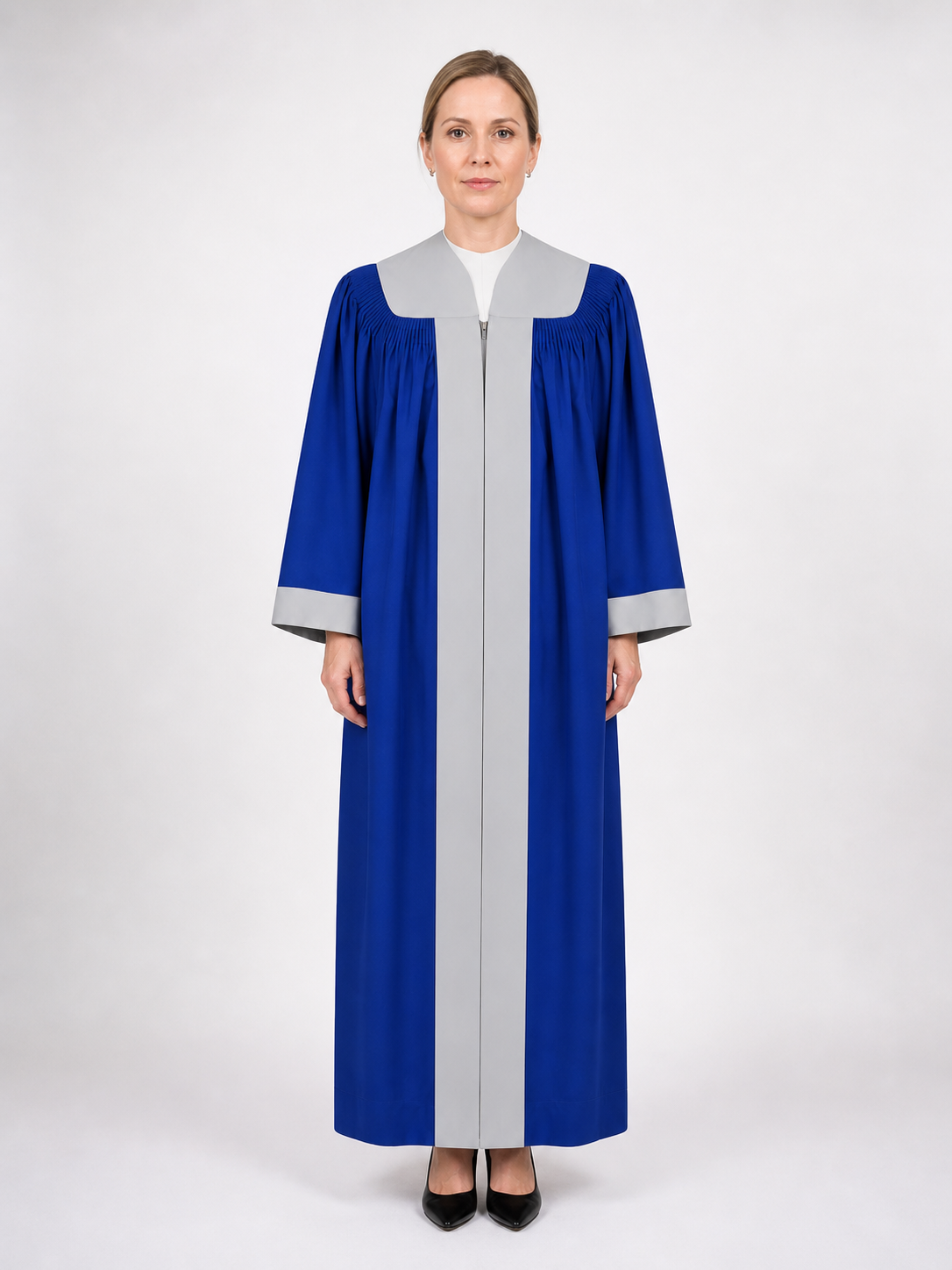
The Bicolora is a full length pulpit robe cut in the traditional preacher and choir robe silhouette, translated for women. The pleated fluted yoke and the flowing skirt are the defining structural elements of this genre of vesture, distinct from the tailored cassock or the fitted clergy dress. Where a cassock buttons down the front and holds close to the body, a pulpit robe hangs from the yoke in full pleats and gives room for movement, gesture and volume through the pulpit and choir loft.
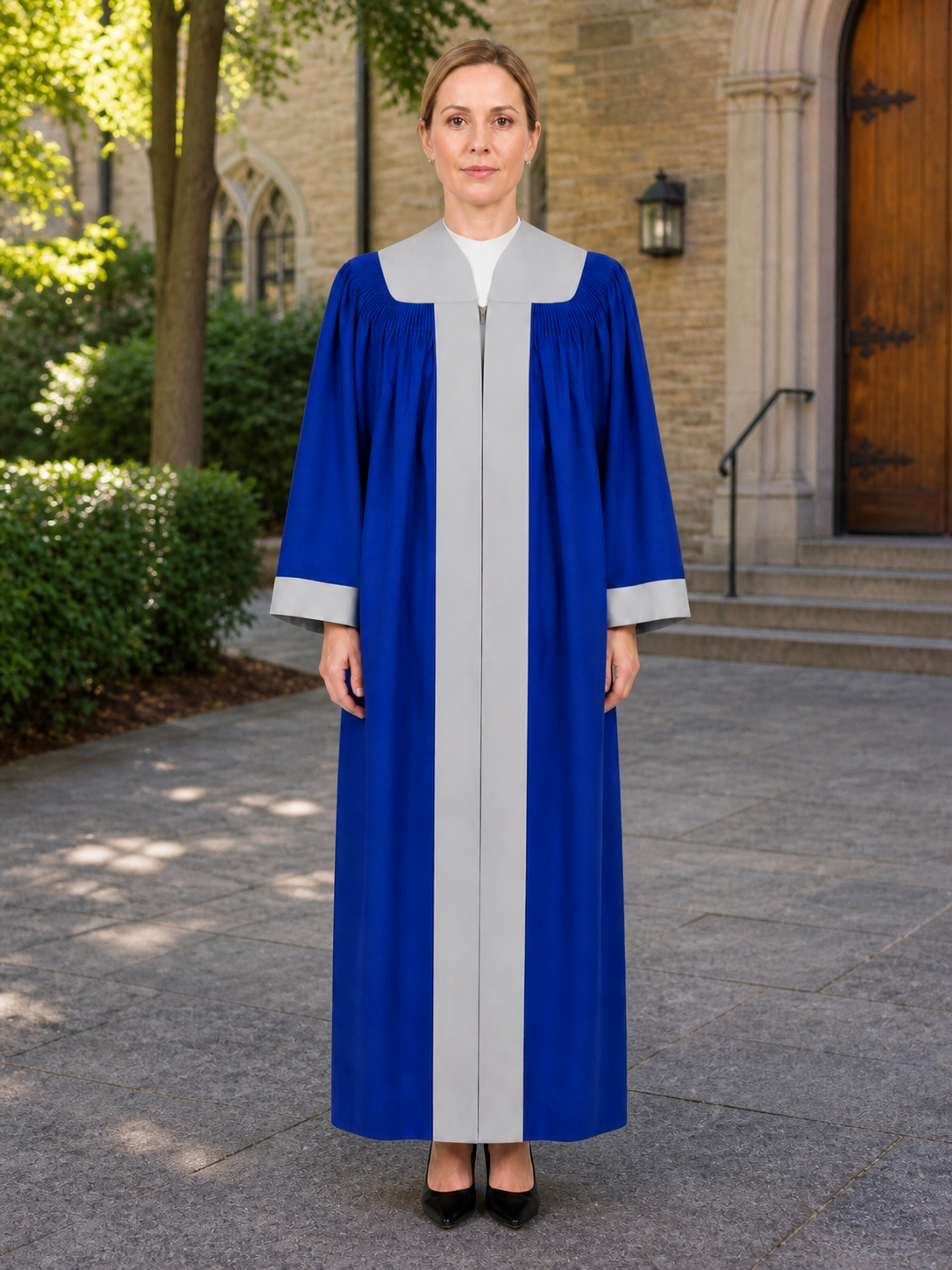
This is the robe worn by women pastors, ministers, worship leaders and choir directors across Baptist, Methodist, Presbyterian, non denominational and independent congregations. It is also the robe of many worship team leaders and cathedral music directors. The Bicolora is designed for the pulpit rather than for the office, and it reads as vesture the moment the wearer steps into the sanctuary.
The Yoke and the Fluting
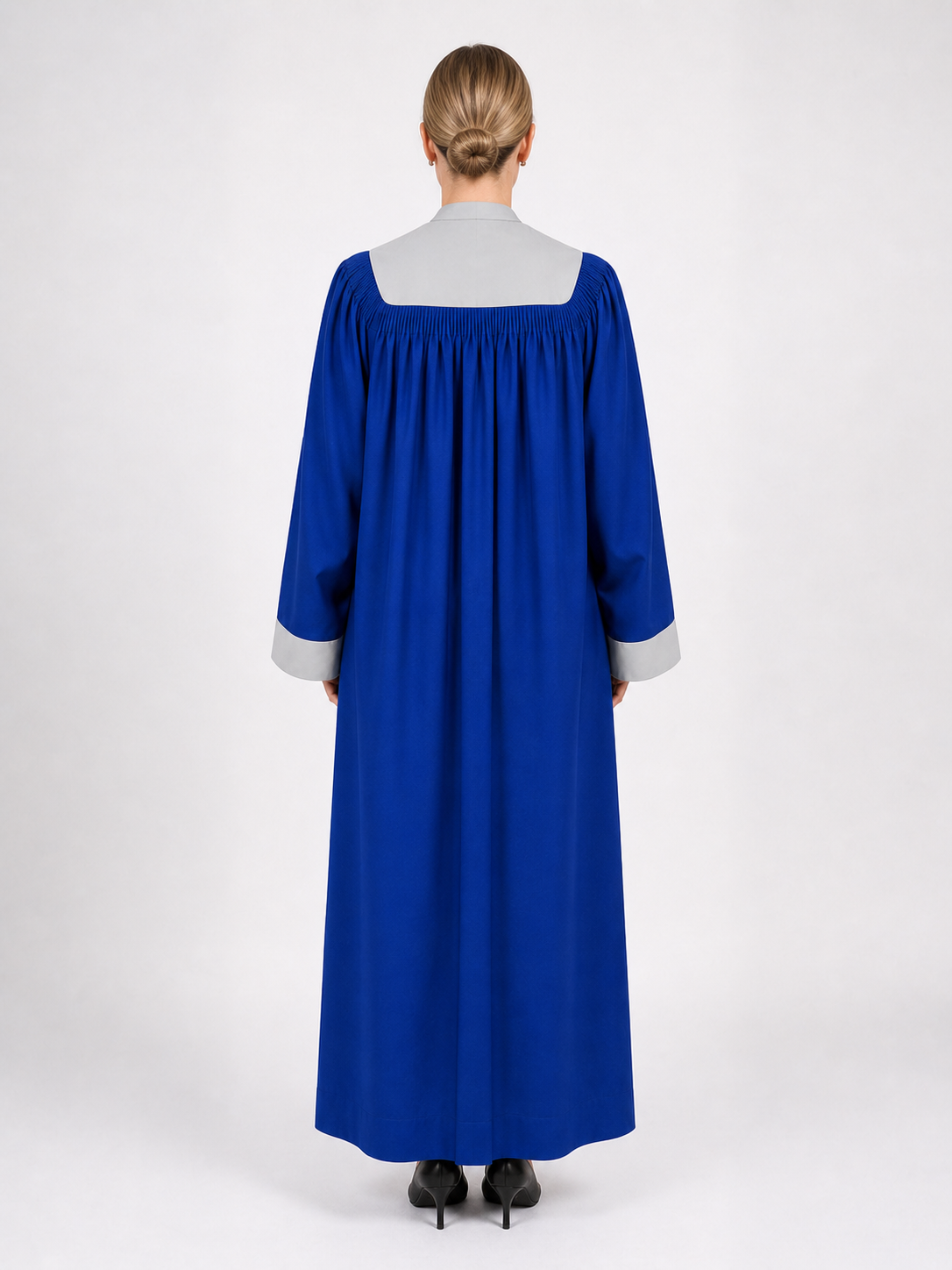
The yoke is the defining structural element. Cut as a shaped panel in the pale grey contrast cloth, it sits across both shoulders and drops in a square line front and back. From the bottom edge of the yoke, the full body of the robe is gathered into deep pleats that flute down through the chest and open into the flowing skirt below.
That construction is not decorative. The fluting is what gives a pulpit robe its movement, its volume in gesture and its presence in the sanctuary. When the wearer raises an arm in prayer, benediction or preaching, the fluted pleats catch the light and move with the body. When the wearer stands still, the pleats hold a clean vertical rhythm from the shoulders to the hem.
The grey yoke against the blue body reads instantly as ecclesiastical composition rather than as fashion detail, since the traditional preacher robe has always been built on a yoke seam of this kind.
The Center Panel
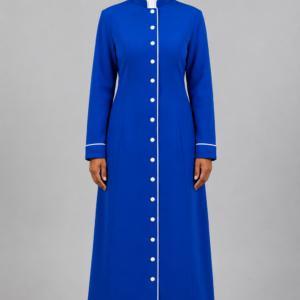
Running from the base of the collar down the exact center front of the robe, a wide grey panel in the same contrast cloth as the yoke frames the closure. It reads visually as a permanent stole worn as part of the robe rather than layered over it. The panel is broad enough to hold the eye at the center of the body from any distance in a full sanctuary, and its color continuity with the yoke and cuffs ties the whole robe together as one composition.
At the throat, the panel opens slightly at a stand collar of the same grey cloth, sized to hold a standard preaching tab. From there it runs unbroken to the hem, so the eye follows a single grey vertical from head to foot.
The Sleeves and Cuffs
The sleeves are cut full and open in the traditional pulpit style, wide enough through the arm to accommodate the fluted body of the robe and to move with the gesture of the preacher. Each sleeve ends in a deep grey turn-back cuff that shows five or six inches of contrast against the blue. The cuff width is set to match the depth of the yoke, so the grey elements at the head and hands balance across the vertical of the robe.
Fabric and Care
Cut from a high quality lightweight tropical fabric. In a full length pulpit robe with fluted fullness and a contrast yoke worn under sanctuary lighting for extended services, the weave matters twice over. It moves air, which keeps a robe with volume through the body and sleeves wearable through Sunday services, revival meetings and warm summer worship. And it holds pleats cleanly on the hanger, so the fluting stays defined rather than falling flat between wears.
The royal blue face is saturated and matte. The grey pieces are cut in the same weave in a soft pale tone, so the contrast reads clean rather than glaring. Under sanctuary lighting the blue stays deep and the grey stays soft, and the pair reads correctly on camera at any distance.
Care: dry clean recommended, both to protect the blue depth and to preserve the crispness of the fluted pleats. If you launder at home, wash cold on a gentle cycle with a color safe detergent. Hang to dry on a padded hanger with the yoke supported so the pleats hang freely. Steam lightly, do not press.
Sizing and Made to Measure
Standard sizing runs in four paired bands, XS/S through L/XL, with Plus 1X and Plus 2X for extended fit. Because a pulpit robe is cut with volume through the body from the yoke down, fit is measured at the shoulder and yoke rather than at the waist. If you sit between two bands, choose the band that fits your shoulder width best, since the body of the robe accommodates a range of figures below the yoke seam.
Made to measure accepts shoulder, bust, sleeve length and full length, with a lead time of about 3 to 4 weeks from confirmed measurements.
FAQs
Is this a cassock, a clergy dress or a pulpit robe?
A pulpit robe. The pleated fluted yoke and the full flowing body distinguish it from a tailored cassock or a fitted clergy dress. It is designed to be worn as vesture on its own in the pulpit and choir loft, with the sleeves open for gesture and the body loose for movement.
Which traditions typically wear a pulpit robe like this one?
Baptist, Methodist, Presbyterian, non denominational and independent congregations across the United States and internationally. Worship team leaders, choir directors and cathedral music directors also wear this silhouette. The blue and grey combination is common in choir and pulpit vesture, though the meaning of the color pairing varies by congregation.
Does the collar take a standard clerical tab?
Yes. The stand collar at the top of the center panel is cut at the traditional height and holds a standard preaching tab. The tab shows sharply against the grey collar. Tabs are not included.
How does the sizing work on a pulpit robe compared with a tailored dress?
Sizing on a pulpit robe is measured at the shoulder and yoke rather than at the waist, since the body is cut with volume from the yoke down. Choose the band that fits your shoulder width best. The full body of the robe accommodates a wide range of figures below the yoke seam without adjustment.
There are no reviews yet. Be the first one to write one.