
Why Burgundy Instead of Scarlet
Red is the loudest color in the liturgical set, and not everyone wants all of it. Scarlet and cardinal push forward. Burgundy pulls back. Same family, very different behavior in a room.
The ground here reads close to #4B1C20, a deep oxblood that sits at true red hue with the value dropped a long way down. What that buys you is range. A bright red garment announces the occasion, which is right at Pentecost and too much on a Tuesday evening. Burgundy carries the same associations without insisting on them, which is why it tends to be the red clergy actually reach for outside the high feast days.
One thing worth flagging, since most listings will not. Traditions that specify liturgical red usually mean a true red, and burgundy sits at the edge of that definition. If you are matching a burgundy brocade apron to a red chasuble or stole for Pentecost or a martyr’s feast, hold the two together first. For general use it is excellent. As a strict season match it depends on how precise your tradition is.
Reading the Weave
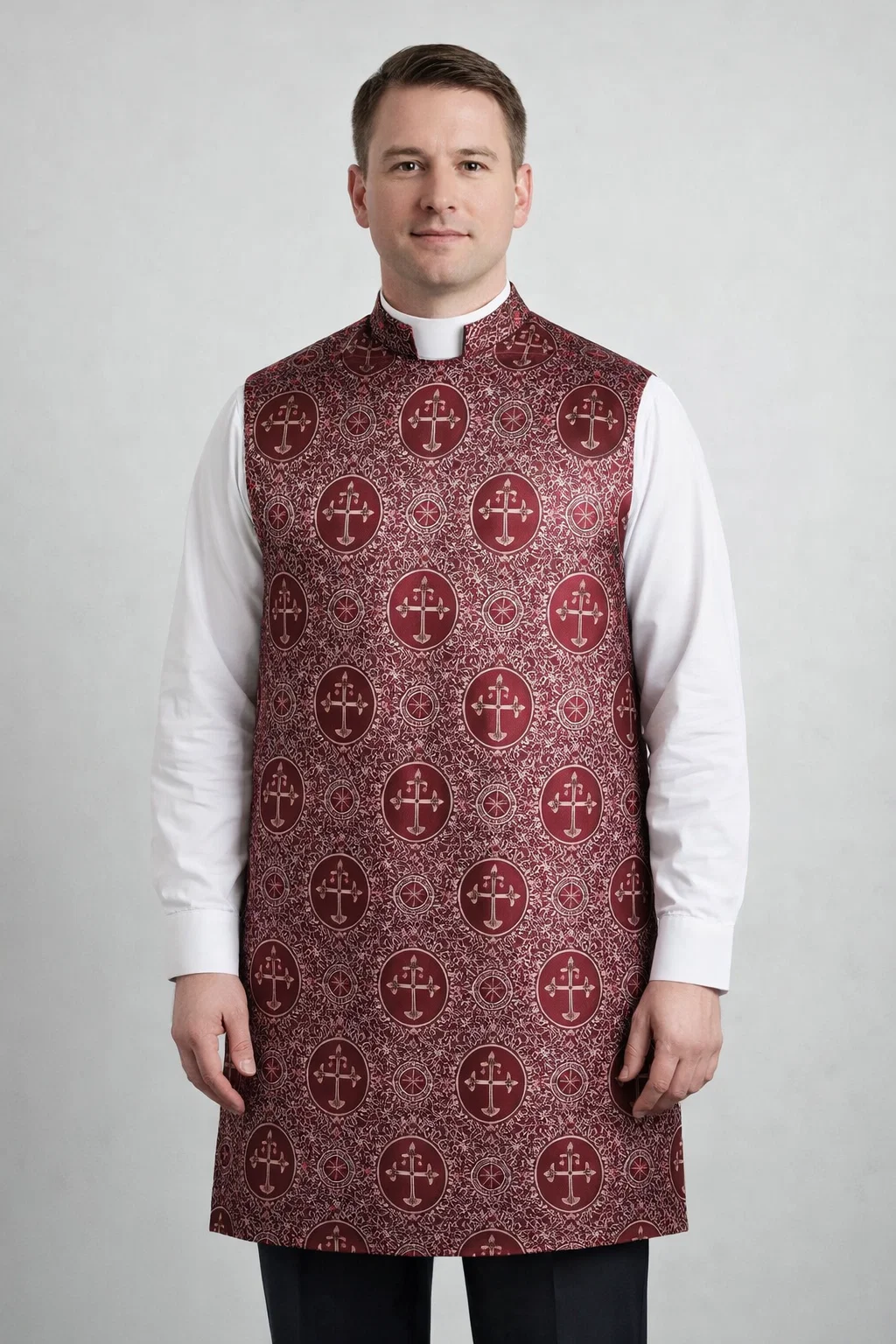
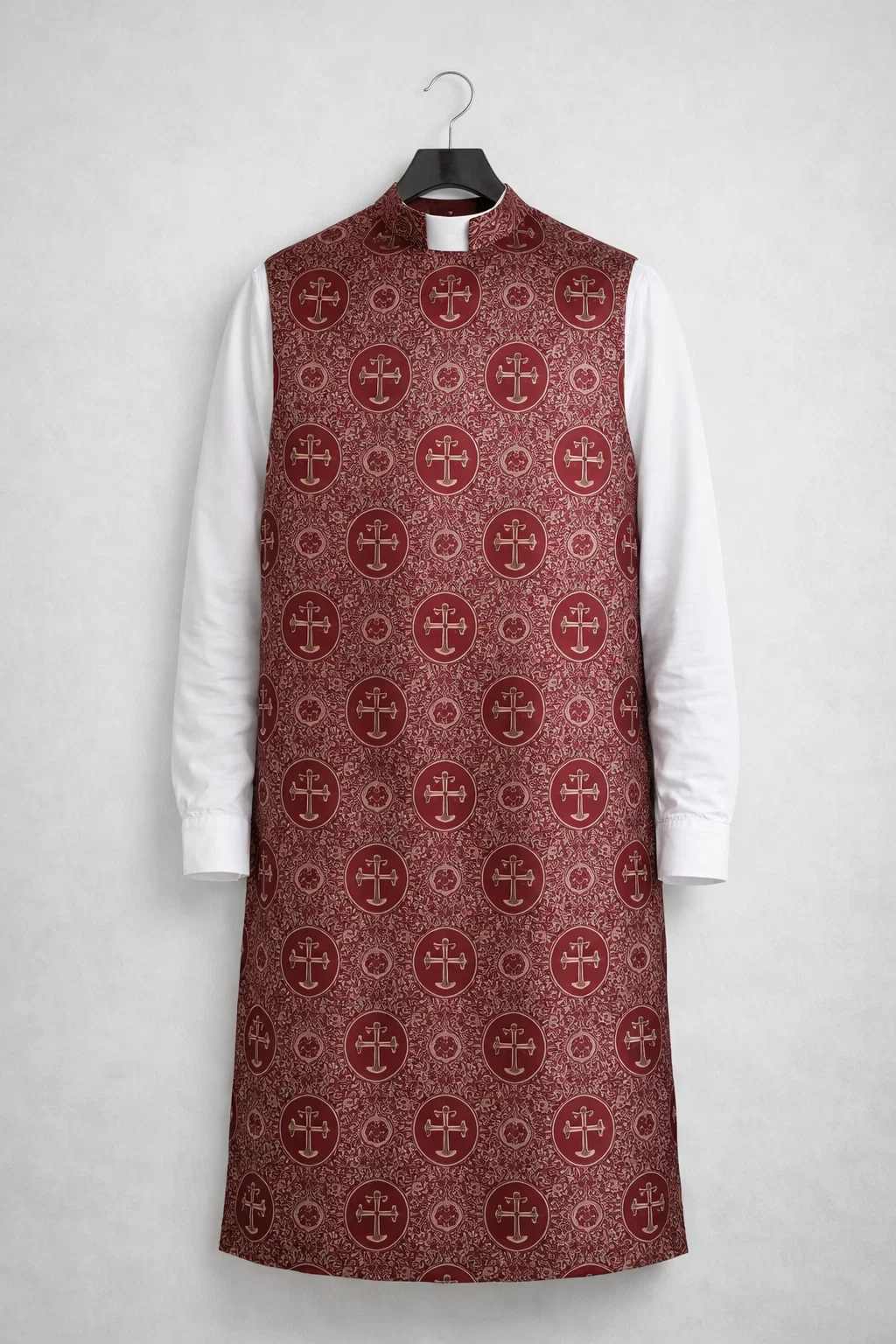
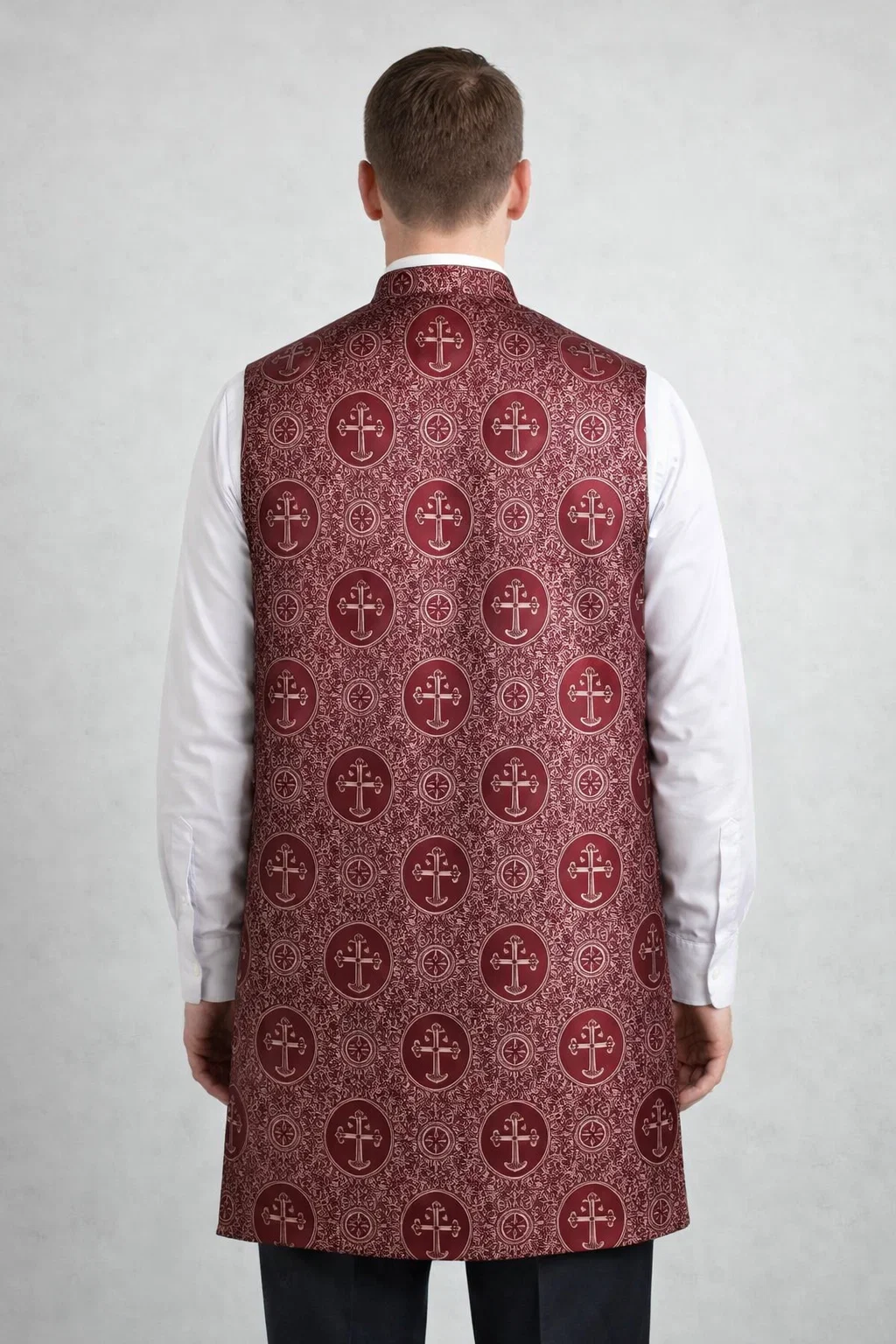
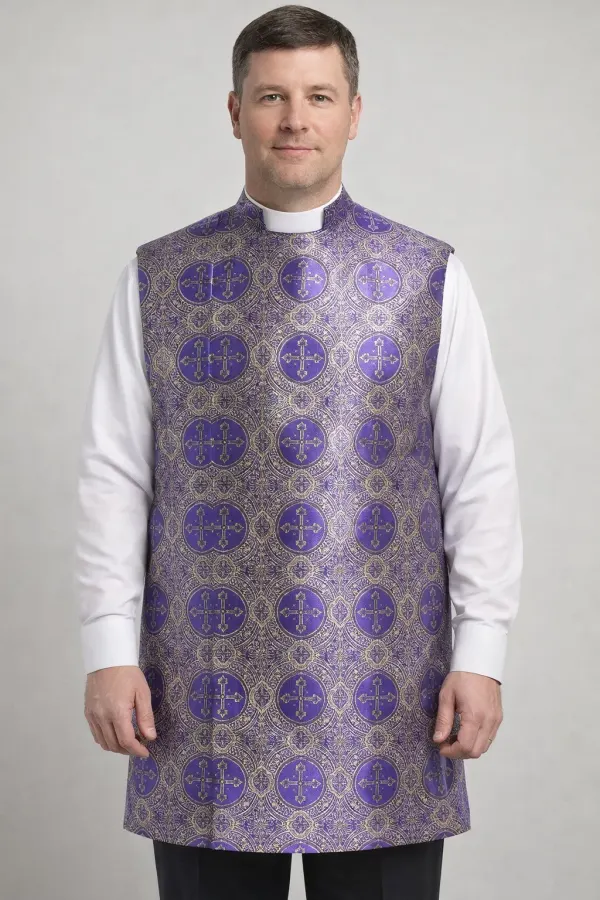
The pattern is woven, not printed. Circular medallions carry ornate crosses, smaller rosette medallions sit between them, and the ground fills with scrolling foliate vine so no plain cloth shows anywhere.
What separates this from a subtle tonal jacquard is contrast. Measured against the oxblood ground, the motif sits roughly fifty six points lighter in value, landing at a pale blush close to #D9ABAE. That is a wide gap, so the crosses resolve clearly from across a room instead of reading as texture only up close. The hue stays in the same red family throughout, though. No gold, no silver, no second color introduced anywhere. The result shows real pattern while staying monochrome, which is a harder balance than adding a metallic and considerably easier to wear.
The Cut, and Who It Suits
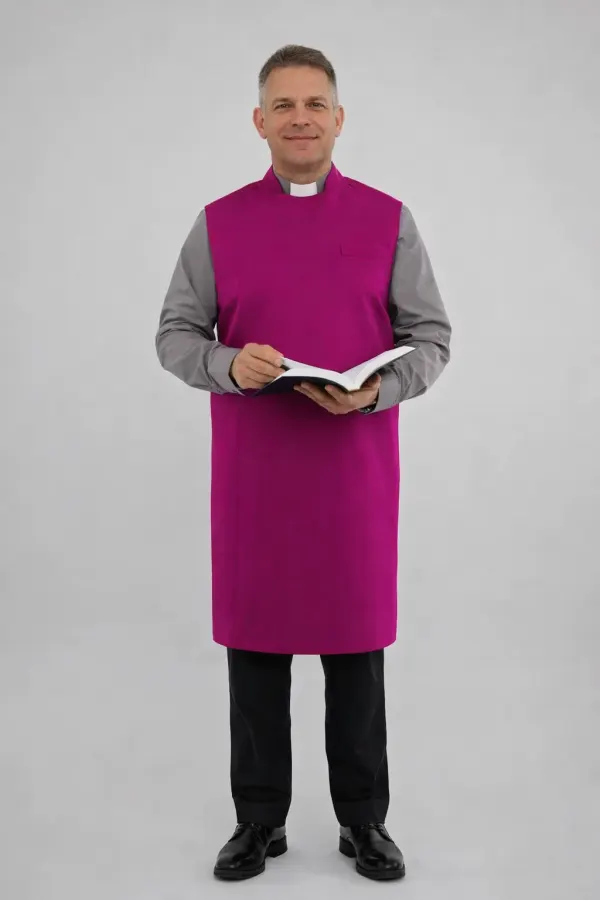
The hem falls at mid thigh, so this wears as a tunic over shirt and trousers rather than standing in for a cassock. The body is cut with a light A line that skims instead of clinging, shoulder and side seams are closed, and the armholes are deep and cleanly finished. The banded stand collar is interfaced to hold a standard clerical insert. There is no button placket, so the medallion grid runs unbroken from collar to hem, front and back alike.
Short length suits lectern work, teaching, camera and conference settings, and anyone who wants the presence of a vestment without a floor length garment to manage on stairs. Worn over the white shirt shown here the pale motif picks up the shirt and the whole outfit lifts. Over black it reads heavier and more formal.
Fabric and Care
The base is a soft quality tropical fabric, lightweight and comfortable through a long service, with the brocade woven into it rather than laid on the surface. Weight matters on densely patterned cloth, because dense pattern usually means heavy pattern, and a heavy short tunic drags at the shoulder seam within an hour.
Care: dry clean recommended. Never press the brocade directly. Steam from the reverse at low heat with the garment on a hanger, then let it settle. Hard pressing flattens a woven pattern and the depth does not come back.
There are no reviews yet. Be the first one to write one.